Conference talk given at the Fifth International Graphic Novel and Comics Conference, London
Abstract
The past 15 years has seen a resurgence of literary work that could be classed as postmodern. Authors like David Foster Wallace, Michael Chabon, Jonathan Lethem, David Eggers, and Jennifer Egan, to name a few, have created work that deconstructs literary realism utilizing many of the themes that Barry Lewis cites as major components of postmodern literature, although he would call any work created after 1990 post-postmodern (Lewis 2001). Time is a fluid construct to be tampered and played with and there is the preoccupation with portraying a subjective, fractured reality with no reliable narrator that eschews the conventions ascribed to literary realism and structuralism. Comics, with the medium’s unique ability within printed matter to transcend the specificity of the written word via the dialogue between text and images, provide even more opportunity to break down these constructs. There are also reading structures that are specific to the grammar of comics that can be utilized to challenge reading conventions. It may be of little surprise then to learn that some of the authors mentioned above have also penned comics as part of their oeuvre. This is not to say that these writers are attempting to bring a postmodern literacy to comics, but rather that they have joined the body of work that has been created from at least the 1970s that has co-evolved with the prose avant garde. This paper will examine the relationship between postmodern comics and prose, starting with the underground comix scene in the 1970s, specifically R. Crumb’s work, moving on to Art Spiegelman’s 1977 Breakdowns, Spiegelman and Francoise Mouly’s work on RAW in the 1980s and 1990s and then discussing how the movement made its way into more mainstream works by writers such as Moore and Morrison. References Lewis, Barry. 2001. “Postmodernism and Literature.” In The Routledge companion to postmodernism, edited by Stuart Sim. London: Routledge.
Conference paper given at Cultural Politics of Memory Conference, Cardiff, UK
Abstract
As the medium of comics has matured and garnered legitimacy as a literary form, the graphic memoir has emerged as the genre that most consistently draws critical praise. Creators such as Art Spiegemlan, Mary and Brian Talbot, Marjane Satrapi, and Allison Bechdel, to name a few, have all received awards and plaudits for their autobiographical work. Yet, presenting memoirs as graphic narratives compounds issues of objectivity and authenticity that are inherent in autobiographical writing. Autobiography poses questions around authenticity unique in non-fiction writing. An autobiographer may use facts, figures and first-person accounts, much like a historian, but those who choose to recount their own histories must also rely on much more ephemeral sources. For all memory is fallible and fragmentary, it still serves as a prominent source for many autobiographers. The process of reconciling your memories with what others present recall and squaring these collected memories with historical events often leads to conflicting reports and incompatible timelines. Questions surrounding the autobiographical self are compounded in graphic memoirs, where self-representation becomes another key to unlocking one’s past. The act of drawing makes the subjectivity of the author manifest in all facets of the narrative. Certain authors have chosen to question the reliability of memory consciously within the body of the work itself. This paper will focus on two key texts that concern themselves with the problematic nature of the author-as-narrator: Alison Bechdel’s Fun Home, and David Small’s Stitches. Each typifies specific methodologies that comic authors have employed to establish truth within autobiographical narratives: reflexively focusing on fictionalization and memory; and suspending the separation between the reality of the external world and the internal world of dream and imagination. I will analyze how each creator has used their approach to handle concerns of fidelity, authenticity, and truth.
Kat Lombard-Cook, a participant in the upcoming inaugural Glasgow event of Laydeez Do Comics, writes about the group for TYCI.
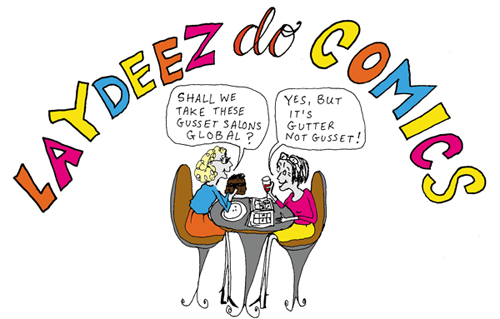
On Monday 10 FebruaryLaydeez Do Comics adds another city to its roster of much celebrated women-led comics forums. This time, the city happens to be our own Glasgow. Given Glasgow’s rich history of comics-making, having possibly given birth to the world’s first comic, it’s wonderful to have a new way to engage with the community, and have it celebrate and encourage women creators.
Laydeez Do Comics, or LDC, launched in 2009 by a pair of women creators, Nicola Streeten and Sarah Lightman, and is ‘the first women led graphic novel forum in the UK’, according to the website. In the intervening five years, they have managed to codify the format for their book group cum artistic and academic forum and been able to expand from their London base to spout groups in Dublin, San Francisco, Leeds, Chicago, and now Glasgow. The groups all meet regularly, although that may mean monthly or quarterly. Details of upcoming events can be found here. All events are either free, or are donation-based, with no event costing more than £5. Each event is also covered by a guest blogger, which means that the websites of each chapter contains a wonderful archive, a slice of that city’s activity in the comic’s sphere. (The locations in the UK are all collected on the main Laydeez Do Comics blog.)
LDC is part of a growing movement across comics to raise the profile of women in the industry, encourage inclusiveness, and encourage women and girls to become involved in comics. Groups like Women in Comics, Europe put women in touch with each other and the wider world, as well as provide a place for support and encouragement. One of the moderators of that group, Maura McHugh, collates and updates a list of women working in comics in Ireland and the UK.
While LDC events are all run by women, the format is inclusive and has hosted a wide range of speakers — the main remit being to foster a conversation with a ‘focus on comic works based on life narrative, the drama of the domestic and the everyday’. There is a democratisation of production and content, with emerging artists sharing the same billing as long-time professionals, academics and bloggers. This openness encourages artists to present work that may still be in process, as well as finished work. Knowing that the audience comes with few pre-conceived notions makes the environment feel safer for artists to discuss struggles and roadblocks in their work.
Personally, I am encouraged by this sort of breakdown of hierarchies within comics. Comics have been plagued with issues of legitimacy, courting ‘high art’ while trying not to be co-opted by galleries, and struggling to stay true to the medium’s working-class roots. The medium has been trying to shake off labels at every pass, so applying them within the community seems counter-productive at times. Everyone who works in comics, no matter what their involvement, is connected by a love of the medium and its ability to tell unique stories. This is what brings us together to discuss our particular projects.
Glasgow’s first event features a diverse range of practitioners: myself, Kat Lombard-Cook, a practice-led PhD student; Neil Slorance, an illustrator whose recent work includes ‘The Amateur Astronomer’s Journal’ and ‘Dungeon Fun’, which is written by Colin Bell; and Morag Kewell, who surprised many who knew her for her sculpting talents, by creating the wonderful travelogue ‘Big in Japan’ in 2013.
It makes a lot of sense for this kind of event to be happening in Glasgow, where there is a thriving independent comics scene. While the mainstream comic world may still be stacked in the favor of men, independent comics have been much more open to a diverse range of creators. This can be seen in discussions and panels like the Diversity in Comics Panel held at Thoughtbubble this past year, which was moderated by Louise Crosby of Leeds’ LDC.
Gill Hatcher, who spoke on that panel, is also part of the organising team for the new Glasgow LDC. She says of the new venture:
Glasgow has seen a rapidly growing enthusiasm for comics and graphic novels over the past few years… Laydeez Do Comics Glasgow has come at the right time, bringing a unique opportunity to the scene, particularly for those who are interested in indie / alternative comics and graphic novels. It’s a chance for people to share their enthusiasm, learn from each other’s experiences and be inspired. The friendly, laid-back atmosphere will also help people to meet like-minded people and network.
Gill is also the creator and co-editor of Team Girl Comic. Through TGC, Gill has encouraged many women to begin publishing their comic work. Gill had started TGC when she felt a bit alone as a woman in Glasgow’s self-publishing world, and she has helped develop a thriving, growing network of women, Glaswegian creators. TGC itself produces four zines a year, and a weekly webcomic, but many women who started contributing to the zine now produce their own small press comics and webcomics. This year will see the 10th issue arrive, which I’m very much looking forward to.
Glasgow also has an active academic engagement with comics. There was a one-off LDC held in the CCA last summer as part of the joint IBDS/Comics & Graphic Novel Conference that was held at Glasgow University. LDC founder Sarah Lightman received her PhD from Glasgow, and Lise Tannahill, another of LDC Glasgow’s organizing team, is currently working on her PhD there. A few more of us call Glasgow home, even if our research is tied to other universities.
This mix should lead to some fascinating forums in the months to come. I am very proud to be part of the inaugural Monday 10 February at the Pearce Institute and I hope that this forum brings another method for engaging with the already rich and active comics community in Glasgow. Hope to see some of you there!
Conference paper given at Scotland And The Birth of Comics, Joint International Bande Dessinée Society/International Graphic Nove and Comics Conference 2013, Glasgow (Jun 25, 2013)
Abstract
The demand for digital comics has increased steadily with the growth of the mobile market. While many comics can be easily converted using existing delivery channels like Comixology or the Kindle app, comics that push the boundaries of narrative find this transition more difficult. Many of these nontraditional narratives are non-linear and involve greater engagement from the reader: Jason Shiga’s choose-your- own-adventure style comic Meanwhile serves as a valuable example of such a story. Most of the current distribution channels either emulate the visual metaphor of a book via page turns, or attempt to lead the reader from panel to panel using a guided view, but Meanwhile requires more active participation than in allowed for under these models. Shiga took the route of developing a stand-alone iPad app for his book, which incorporates the interactive elements of his physical comic. I will discuss how successful the app was at translating the experience of the book object to the digital realm, and what lessons can be taken from it by creators who wish to engage with their readers digitally.
A lot has already been written in a relatively short amount of time about Chris Ware’s remarkable new “book” Building Stories. (Book is in quotation marks as the story is told via a series of pamphlets, books, broadsheets, and an oversized screen that resembles nothing so much as a board game.) The Comics Journal ran a series of essays at the time of its release; contributors to Chris Ware: Drawing as a Way of Thinking were given the chance to revisit their essays which explored work previously published by Ware that eventually became Building Stories. (http://www.tcj.com/tag/building-stories-essays/) Philip Nel, who taught Building Stories last semester, helpfully has posted not only a plan on how to tackle the book with students, but a fairly comprehensive list of articles and reviews that have been published in the 6 months since its publication. ( http://www.philnel.com/2012/11/09/teachingware/)
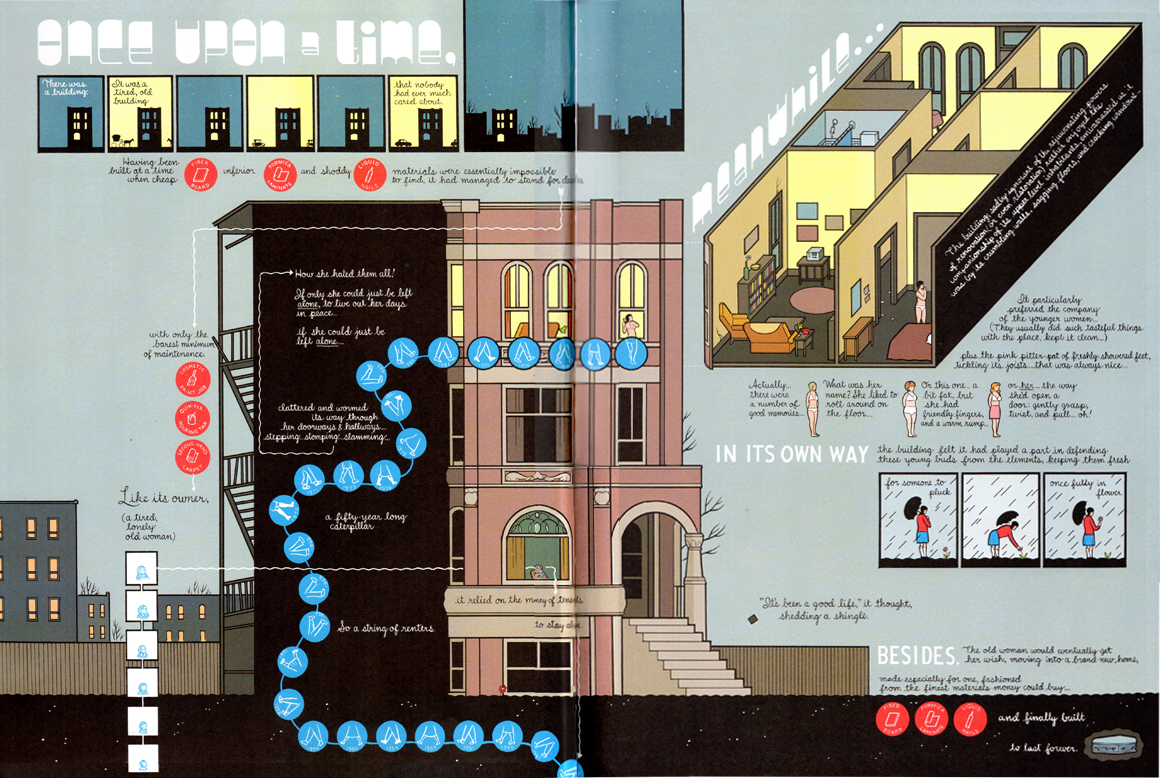
As the general plot and character of the book are covered elsewhere, I would like to focus on the representation of place within the narrative, and the significance of locality to the interpretation of specific story-objects within Building Stories. I won’t touch on all of the objects within the box, leaving out ‘Branford the Bee’, and only glancing upon the pieces set in Oak Park, IL. I want to focus much more on the pieces that revolve around the old tenement-style apartment in Chicago itself. [Note: none of the four characters who inhabit the apartment building are named. It becomes clear over the course of the larger narrative that the main character is the female tenant who lives on the top floor. For ease, I will refer to her as such, and the other characters in relation to her: the downstairs couple, and the old landlady. Ironically, her cat is named, but she has given it the uninspired moniker Miss Kitty, so effectively is as unnamed as the rest.]
In order to get a better sense of the structure of the building he was constructing, Chris Ware actually built a paper model of it. This wasn’t the first model he has made, mind you, as there’s an image dating from 1989 in Tod Hignite’s In The Studio of a model he made for his grandmother of the apartment he was living in. She never had a doll house growing up, so when she asked to see what his studio looked like, he created this simulacra for her (Hignite p 250). Of course, the model of the apartment building is quite a bit larger, and more complex than previous attempts.
Ware also made a copy of the original building model to be displayed at a gallery show that coincided with the book’s launch. When creating the duplicate, he realized it would be no more work for him to make plans that others could use to recreate his building, and so a limited edition companion was created: a “13 sheet collection of dry technical drawings, paper thin walls and cramped psychological spaces.” (http://www.drawnandquarterly.com/shopCatalogLong.php?st=art&art=a3dff7dd568fe0).
Ware has said of these models “they’re something of a joke on memory, how we reconstruct things from our senses, literally rebuilding the world in our minds” (Irving).
The same might be said of the structure of the apartment building itself, a sort of off-kilter rebuilding, mash-up or pastiche of two apartments Ware actually lived in over the years, an amalgamation of a real and imagined Chicago. It’s “like a weird bad memory of or a misremembered version of two different apartment buildings… recombined” (Reid). Ware wanted to create a shell, much like the doll houses his grandmother never had, empty spaces filled with potential energy. We inherently want to make up stories to fill these charged spaces. Ware fulfills this need by not merely telling us about the current inhabitants, but, through the use of the building as a character, allows the reader to know the story of the building itself.
The embodied voice of the building speaks in the two hardbound books in the collection, providing an expanded framework for the story. While most of the stories in the collection focus on the building’s current inhabitants, the voice of the building reminds the reader that, while these may be unique individuals, little in the routines of their lives is significantly different from any of the previous litany of tenants over the past hundred or so years. This is not to say that each person is just a blank automaton fulfilling robotic gestures, dictated by the space they live in; the building has empathy for its tenants. When the woman downstairs storms away after a fight, the building plaintively calls her back, even though it knows that she will never be happy with her boyfriend. The building has a bit of foresight into the lives of its tenants, at least for the duration of their stay. Yet its own future isn’t so clear as it once was; the landlady is growing older and has no family to inherit the house once she passes away.
The realities of short leases, brief stays and a hurried city lifestyle may cause us to wonder if any trace of us remains in these places which anchor our daily lives. Do we leave psychological marks behind, as well as holes in the wall? When Jacob Brogan revisited pieces of Building Stories for his essay, ‘From Comics History to Personal Memory’, he discusses a sequence where the reader sees a tabulation of occurrences within the building’s walls:
Building Stories turns from problems of the collective past to questions of personal memory…. What we find here, then, is something like a sedimented record of all those everyday banalities that must go forgotten if we are to continue going about our lives. Like the apartment building itself, which disappears into the weave of the text as a whole, these are the things we leave behind as we mature.
The house is a repository for the collected lives of those who have come before, and the few yet to come.
While we leave marks on the places we inhabit, we must also acknowledge how much these places shape us as well. Tom McCarthy’s book, Remainder, is focused on a man who tries to exactly recreate a place he lived in an attempt to evoke a feeling he has lost. It’s something as subtle as passing between a couch and a counter while his shirt just barely tugs along a rough edge of the counter ledge that takes him back to the state of mind he longs for—a motion he performed countless times without ever paying it any mind, which etched itself into his subconscious. In an interview with Chris Mautner, Ware discusses this link between the physicality of space and mnemonics:
My incessant use of rulers is more of an attempt to get at how houses and buildings affect the shapes and structures of our memories, and how these shapes can continue to live on in our minds years or decades once the buildings are gone. For example, when one comes down a stairway day after day after day, something gets imprinted on the memory and the mind about rounding a corner and grabbing a banister in a very primal, almost non-verbal way. Even though it’s not an “image” exactly, that shape or the shape that movement creates is just as much a memory as how a house or a person looked at a given time, and it can shape dreams and even experiences, inducing recollections to arise at odd, unexpected times whenever a corner is rounded and a banister is grabbed.
This physical deja vu speaks to how deeply we internalize the spaces we live in. In a way, this is the real-life version of the memory palace that Romans used as a mnemonic aid, associating certain facts or ideas with spaces in an imaginary room. Rather, actual memories are tied to the physical spaces and objects we mindlessly interact with daily. In his Globe and Mail article, Jeet Heer asserts that part of Ware’s genius is his ability to use architectural constructs to show the symbiotic relationship between building and residents. The main character even muses out loud about the link between architecture and memory after a conversation with her landlady. The older woman discussed her old artwork that is stored in the attic, leaving the main character to wonder:
Why is it always in the *attic* where we banish our past? Is it because, since it’s always above us, it feel analogous to our minds?… I wondered if maybe somewhere there was a culture that imagined its memories residing somewhere other than in the brain, like in the heart or in the feet, and if they built their houses accordingly, storing things in the middle, or in the basement (10am September 23rd 2000).
This concept is obviously more thoroughly realized in the sections pertaining to the apartment building, but there is still some semblance of these themes running through the Oak Park material. Truth be told, when I was first making my way through the box, I thought that the Oak Park material was divergent and was disheartened to see how much of the narrative was set there. But as I waded through the pieces and started to figure out that the whole story is filtered through the main character’s imagination, I started to appreciate the subtle cross-references that tie the whole work together. For example, in the aforementioned conversation, the landlady would never have said her art was in the attic, because she would have known that the building she spent her whole life in didn’t have one; that her things were all in the basement. The main character is only alerted to the lack of an attic when a previous tenant comes to fix her plumbing. While the home she moves to with her husband doesn’t speak in flowing cursive lettering, that doesn’t mean its character doesn’t have a similar impact on the protagonist’s life (Worden).
Ware plays with readers’ understanding of place in more ways than bestowing the building a voice. I found one of the slighter objects in the box to also be one of the most formally interesting. The primary conceit in Building Stories is that each person will make their way through the collected objects in a different order. The reader has to choose their own method, and I chose to read the story from the smallest objects to largest. This meant that I approached the silent, flip-book-style story fairly early on. I did not have the context from the larger narrative to frame this story-object, so took much of it at face value.
Upon first reading I worked out that each page seems to take approximately one season, and tracks the development of the protagonist’s daughter. I also made some erroneous assumptions. For example: the father leaves for work in the 5th spread and does no appear again until the 19th, originally leading me to think that perhaps the couple had split up or taken a break, when actually, I had missed that each spread also accounts for one hour in the day, chronologically, so he simply went to work and returned, albeit a fair bit older. I also took for granted that each of the rooms I was presented with were stable (i.e. the living room we are shown in spread 4 is the same as 7). As a reader, we assume a certain amount of stasis in the places we are shown. Yet the bedroom the protagonist is shown sleeping in shifts without any warning, and very little visual indication. On the first page, other buildings in urban Chicago are clearly seen, marking the setting as the apartment building, but in the 3rd spread, the protagonist looks out the window and sees the front path of her Oak Park home. Only after reading several other pieces did I become aware of enough of the larger story to understand this shift in place had occurred. Ware subtly betrays the reader’s expectations to foreground preconceptions surrounding place and location in traditional narrative.
Location grounds us in time, as well as space. My understanding of the change in location in the previous example came as much from my knowledge that the protagonist moves home around the time of her daughter’s birth as it did from the view out her window. Jeet Heer, Daniel Worden and Matt Godbey all draw attention to time in relation to Ware’s use of architecture, focusing on the apartment building as the locus for a shift in the perceived “historical scale” of the narrative (Worden). While Godbey argues that “Building Stories is… a project obsessed with [a] lived experience of time”, he also notes that the presence of the building, as a fixed point in a changing city, alters the reader’s perception of the time-scale involved in the narrative. The building acts as a sort of archive, locating the current cast of characters within a history of tenants whom they are, mostly, unaware of. The former inhabitant, now plumber, reminds the protagonist that she lives in the current version of the house, in the current version of Chicago. This notion is thrown into even sharper focus in one of the more jarring episodes within Building Stories; the reader is wrenched hundreds of years into the future, where a woman is accessing the emotional past associated with her location, and watches the actions of the couple from downstairs at an El stop. This is still Chicago, with its elevated trains speeding through the city, but it is not our Chicago of “now”, or the building’s Chicago of the early 20th century.
Ware utilizes locality and architecture to problematize the reader’s understanding of time and place in the multi-textual Building Stories. The looping cursive voice of the apartment building anchors the narrative’s past, at least as far back as the elderly landlady’s childhood memories. As Chicago grows around it, the building grounds its inhabitants. Each new tenant enacts similar patterns to the one who came before, be it kicking their shoes into the same corner or staring out the same window when planning their lives. We are seldom conscious of the patterns our dwellings instill in our lives, and it is perhaps the very effortlessness of these banal habits that imprint them so deeply in our memories. As Heer says, “All of us are boxed in. This sentence can be taken as a figurative description…, but it also happens to be literally true. We are born in boxes, live in boxes and die in boxes.” Ware deftly draws our attention to these innocuous moments and makes the reader aware of the importance buildings have in our lives.
Kat Sicard recently completed a Masters’ at the Glasgow School of Art, where she explored definitions of “the book” and how interaction can shape understanding. During her time there, Kat became interested in the structuralist constructs that are inherent in how we understand comic books and created work around manipulating and subverting these constructs to challenge the reader. Currently, she is researching how comic books can be used to interrogate and analyze narrative structure. Kat is working on a practice-based PhD and will be making work that questions the form and format of the comic book and encourages the reader to engage with the work in non-traditional ways.
Talk given at Adventures in Textuality Conference, Sunderland, UK (Apr 4, 2013)
Abstract:
As a genre, autobiography poses questions around authenticity that may not plague other non-fiction authors. An autobiographer may use facts, figures and first-person accounts, much like a historian, but those who choose to recount their own histories must also rely on much more ephemeral sources. Memory is hardly the most reliable of human faculties; it is undeniably selective and subjective. When the source material is your own life, how do you adapt it? The writer must reconcile what they remember with what others present recall and then square all of these memories with historical events. This often leads to conflicting reports and incompatible timelines. The writer must decide if it more important to give a factually accurate record of events, or be true to their memory. In recent years, a significant number of memoirs have taken the form of graphic novels. Visual narratives present an opportunity to use different techniques than in traditional prose. Time behaves differently on a comic page than it does on a textual one. This is something that the comic artist can take advantage of when structuring their story. Some creators have used external events to ground their memoir, such as how changes in the political landscape in Iran are key to ‘Persepolis’ by Marjane Satrapi. Other writers have decided to recognize the disparities of memory and make that an inherent part of the text; ‘Fun Home’ by Alison Bechdel reframes certain events multiple times, highlighting the subjectivity of recollection. ‘Fun Home’ also references fictional works in its story construction, yet this does not take away from the legitimacy of Bechdel’s experiences. This paper will compare the different approaches to the adaptation of memory employed by Bechdel and Satrapi in their memoirs, including the distinct ways in which each handles concerns of fidelity, authenticity, and truth.
NOTE: This article was originally published on Infinite Earths on January 25, 2013. Here’s an internet archive that includes my post
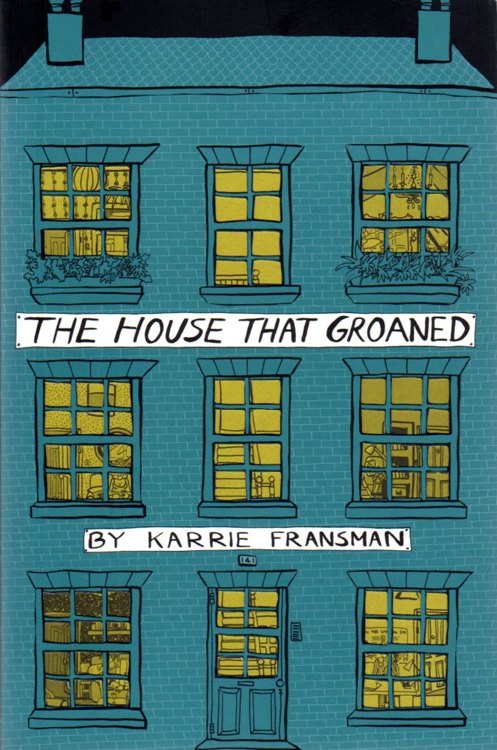
They say that old houses have character, but in Karrie Fransman’s The House That Groaned, the old Victorian where this story is set might as well be a character itself. Built in 1865, it seems to have been left on its own to rot and break apart from the inside out, much like many of its current occupants. Yet, if the building was properly maintained, the lives of those inside would not be compelled to intersect in such a dramatic way. Pipes slip apart allowing conversations to drift down from the upper floors, the boiler bangs with such ferocity it sounds like angry knocking, and stairs buckle under foot, landing one tenant at another’s front door. Fransman allows the rooms’ walls to act as panel borders, and the gutters are filled with the house itself; its machinations evident, bridging the gaps between people’s lives.
The story beings in a fairly straightforward manner; a young woman named Barbara is starting fresh in a new city, and as she moves into her flat, the reader is introduced to the eccentric occupants of her building. By utilizing a structure that the reader feels comfortable with, Fransman is able to challenge our expectations of these characters and pose some complicated questions. It is obvious from the outset that each occupant is emotionally damaged in some way. Over the course of the book we find that every one of them has been abandoned or let down in some traumatic way that has left a hole inside them. It is the divergent way that they satisfy their loneliness that sets up the reader’s judgements about them.
There’s the insensitive cad Brian, who lives on the ground floor, and only dates women who are terminally ill or disfigured. He must be preying on vulnerable women. Janet, who lives across from him, gives weight loss classes and eats a meager salad at her computer each night. Upstairs, a corpulent neighbor Marion tries to convince her to give up her masochistic self deprivation and enjoy the sensuality of food again. Marion must be trying to liberate Janet from her strict notions of self-worth being tied to waist size. Similar assumptions can be made about the touch-up artist who wears gloves when interacting with others, the old lady upstairs who literally blends into the background and the seemingly ditzy Barbara who wants to be a model.
Just as the reader feels comfortable with their relationship with the characters, Fransman begins to pepper in flashbacks. As the past of each character is revealed, our notions about their moral character shifts and the reader is left in doubt of their own assumptions. In a way, the author seems to be pitting existentialism against moral relativism. Is it what we do or why we do it that’s important in the end? Not that she’s willing to give us any easy answers to this question.
As a boy, Brian had a prolonged hospital stay that left him fixated on death. He truly finds the women he dates beautiful for their pain. The real predator in the house is Marion, who is not preaching self-acceptance but rather a destructive form of hedonistic self-satisfaction. Her wealthy alcoholic parents emotionally abandoned her to fulfill their own desires, and she sees no reason not to recruit others to help her similarly destroy herself. Meanwhile Janet lost weight not in an effort to punish herself, but instead had devoted herself to becoming healthy in order to have a family, which turned out to be unachievable.
Along with confounding the reader’s moral expectations, Fransman makes the reader grapple with their views towards body images. Throughout the book, she depicts her characters in ways that could be considered explicit or gratuitous, but her abstracted style de-sensualizes them. Rather, by unabashedly showing a variety of bodies without shame, the reader’s perceptions of normative body views is foregrounded. The reader must come to terms with how each character’s relationship to body image shapes our feelings towards them. Does the reader admire the dieter for her commitment to a healthy life, or the sensualists unashamed love of her curves, or both? Are we repulsed by the anorexic, obese and disfigured women Brian chooses as his sexual partners? Does his ability to lust after what disgusts us make us uncomfortable about our views of beauty? Then we come to Barbara, who seems superficially “perfect”, at least according to Matt across the hall, who has a phobia of physical imperfection. Her story of coming to terms with a body she is deeply unhappy with leads to the most significant change in appearance of everyone in the house. The casual way that Fransman relates her past makes you realize that transformation is part of everyone’s life, and a dramatic shift in outward appearance should perhaps not be so startling as the transformations that occur within us.
Meanwhile, the house, in the throws of death, shudders and convulses, bringing the occupants together for a few final dramatic moments. In the end, it is Brian’s honest love of the disfigured that saves him and while Janet has a brush with death, they both emerge relatively unscathed and walk away into the sunset together. Other tenants don’t get such happy endings, but in life, few truly do. Fransman tale serves as a reminder that we have only been allowed a few glimpses into the lives of others and real life is not as clear cut as we might expect a story-book to be.
The House that Groaned is published by Square Peg rrp £14.99.
Kat Sicard recently completed a Masters’ at the Glasgow School of Art, where she explored definitions of “the book” and how interaction can shape understanding. During her time there, Kat became interested in the structuralist constructs that are inherent in how we understand comic books and created work around manipulating and subverting these constructs to challenge the reader. Currently, she is researching how comic books can be used to interrogate and analyze narrative structure. Kat is working on a practice-based PhD and will be making work that questions the form and format of the comic book and encourages the reader to engage with the work in non-traditional ways.